

Global Diversity, Equity & Inclusion Benchmarks (GDEIB)
GDEIB approach is grounded in lived experience, meaningful engagement, and evidence-based strategies. Each step is designed to help your organization build intentional, sustainable equity practices rooted in real-world impact.
This tool can assist employers in advancing IDEEAAS work globally or in focusing on a specific subcategory aligned with their priorities and organizational needs.
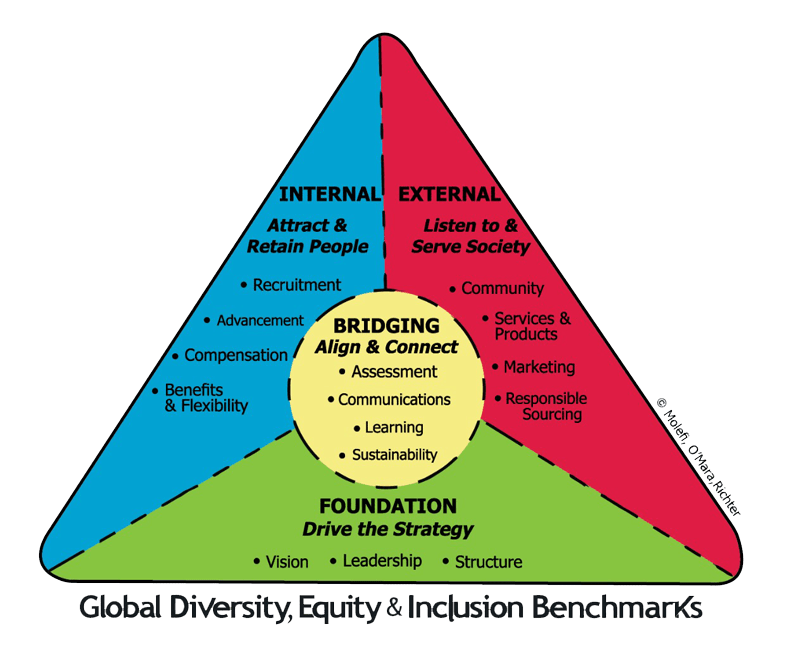
Themes
Foundation
The systems, structures, and leadership commitments that shape and drive an organization’s overall DEI strategy.
1. Vision, Strategy & Business Impact
Defines how DEI aligns with the organization’s mission and long-term goals to create measurable impact.
2. Leadership & Accountability
Ensures leaders champion DEI and are responsible for modelling, resourcing, and tracking progress.
3. DEI Structure & Implementation
Provides the governance, roles, systems, and resources needed to execute DEI work effectively and sustainably.
Internal
Internal focuses on creating equitable, accessible, and inclusive practices that support employees throughout the entire employment lifecycle.
4. Recruitment
Ensures hiring practices attract diverse candidates and remove barriers to equitable employment access.
5. Advancement & Retention
Supports fair promotion pathways and creates conditions for all employees to thrive and stay engaged.
6. Job Design, Classification & Compensation
Ensures roles, pay structures, and advancement criteria are equitable, transparent, and free of bias.
7. Work-Life Integration, Flexibility & Benefits
Provides inclusive benefits, flexible arrangements, and supports that allow employees to balance life and work equitably.
8. Assessment, Measurement & Research
Uses data, evaluation, and research to understand organizational DEI realities and guide continuous improvement.
External
External describes how the organization engages with communities, clients, and society to ensure its impact beyond internal operations is ethical, inclusive, and socially responsible.
9. Community, Government Relations & Philanthropy
Builds equitable relationships and partnerships that benefit communities and society.
10. Products & Services Development
Ensures that products, programs, and services are inclusive, accessible, and responsive to diverse users.
11. Marketing & Customer Service
Communicates and engages diverse audiences respectfully, culturally aware, and in accessible ways.
12. Responsible Sourcing
Promotes equity and ethics across procurement, supplier relationships, and supply-chain practices.
Bridging
Bridging connects internal and external DEI work through communication, learning, and alignment mechanisms that ensure coherence and long-term organizational impact.
13. DEI Communications
Ensures internal and external communication is transparent, inclusive, and aligned with DEI values.
14. DEI Learning & Development
Builds organizational capacity through ongoing learning that addresses bias, inclusion, accessibility, and equity.
15. Connecting DEI & Sustainability
Integrates DEI principles into broader sustainability and ESG goals to support long-term social impact.
Levels
Each organization, whether a business, government, or nonprofit, will be at different stages across the categories and subcategories, depending on its context, priorities, and IDEEAS journey.
1: INACTIVE
No DEI work has begun; diversity, equity, and inclusion are not part of organizational goals.
2: REACTIVE
A compliance-only mindset; actions are taken primarily to comply with relevant laws and social pressures. Doing the bare minimum.
3: PROACTIVE
A clear awareness of the value of DEI; starting to implement DEI systemically. This is what is required and expected of all organizations.
4: PROGRESSIVE
Implementing DEI systemically and showing improved results and outcomes beyond what is required or expected.
5: BEST PRACTICE
Demonstrating current global best practices in DEI; exemplary.
Client experience
We are here to help you better understand where you are, identify priority areas, and develop action plans that support sustainable change management and growth.
Step 1: Initial Assessment
We review your current practices and challenges to understand where to begin and what will have the greatest impact.
Step 2: One-Hour Client Meeting
We meet with your team to clarify your goals, your needs and the outcomes you hope to achieve.
Step 3: Prioritizing Key Themes
Together, we identify the key themes that matter most —such as gender equity, accessibility, belonging, and communication—and organize them into short-, medium-, and long-term priorities.
Step 4: Action Plan and Brainstorming
We co-create a practical action plan supported by a guided discussion. This plan outlines clear steps, timelines and tools tailored to your organization.
Step 5: Strategic Plan and Implementation
We support you in putting the plan into action. This may include policy work, training, program development or accessible communication tools.
Step 6: Review and Strengthening
We revisit your goals, evaluate progress and make adjustments to ensure long-lasting, meaningful change.